

Every industry has its “oh no” moments.
But in trucking? Those moments hit a little harder.
Engines stop. Freight stalls. Phones light up. Safety managers start sweating.
And compliance folks start praying to every patron saint of paperwork.
This week, we got one of those moments.
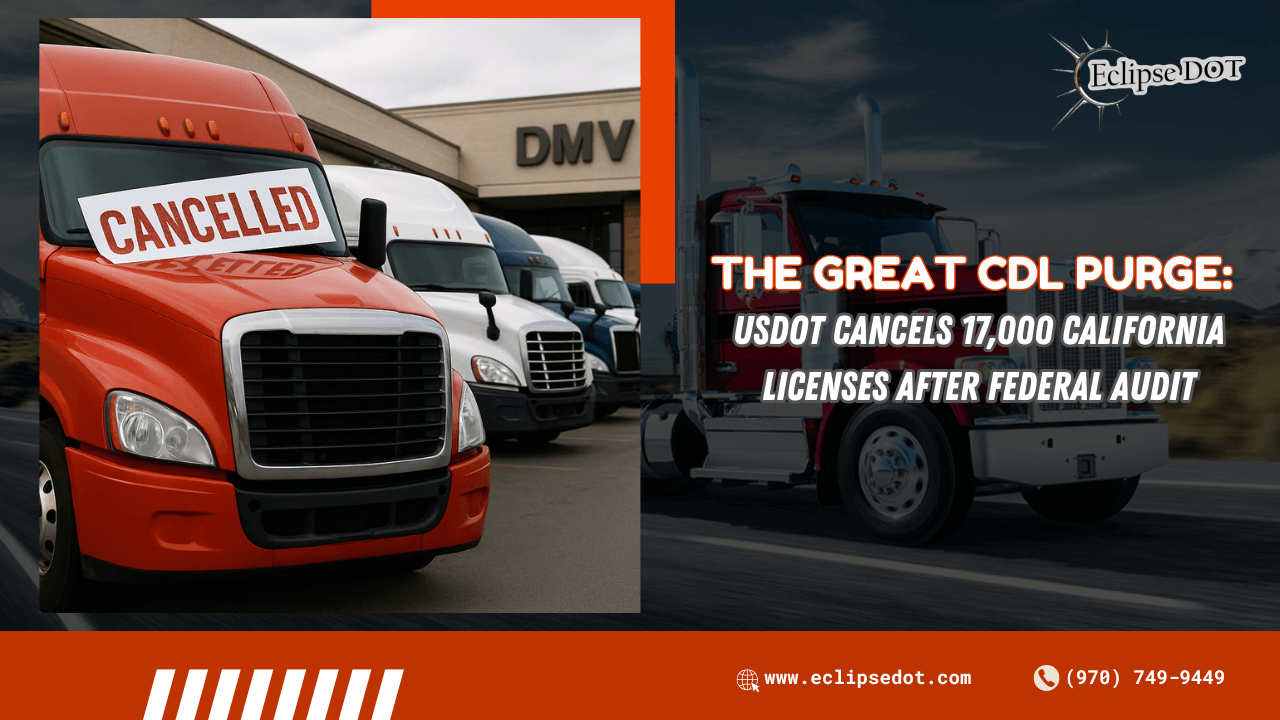
Because when USDOT stepped up to the microphone and announced that 17,000 Commercial Driver’s Licenses issued out of California were being cancelled, it wasn’t just shocking — it sent a tidal wave of panic across the entire trucking world.
This wasn’t a rumor.
It wasn’t a prediction.
It wasn’t a “pending review.”
It was a purge.
A real one.
And if you work in this industry — especially if you lead people, hire drivers, or run fleets — then this situation is a direct warning shot across your bow.
Let’s break down what happened, why it matters, and what you need to do next before your company ends up in the splash zone.
The Fuse That Lit the Explosion
Here’s the short version:
California messed up big time.
But the long version?
That’s where things get wild.
The Federal Motor Carrier Safety Administration (FMCSA) conducted a full audit of California’s non-domiciled CDL program — that’s the process the state uses to license drivers who are legally allowed to work in the U.S. but don’t permanently live here.
And what did FMCSA find?
Not just cracks.
Not just holes.
But systemic failures.
The audit revealed:
-
California issued CDLs to drivers whose legal work authorization had already expired
-
CDL expiration dates that stretched YEARS beyond lawful presence documents
-
Programming errors in the state’s system that let thousands slip through
-
Policy failures that ignored federal regulations
-
And more than ONE in FOUR sampled CDL records that didn’t meet federal requirements
Let me put that into trucking language:
Imagine doing a pre-trip and discovering your tires are bald, your brake chamber is cracked, your suspension is broken, your ELD isn’t working, your fire extinguisher is missing, and your steering wheel is somehow on backward.
That’s the level of disaster FMCSA found.
And when the feds find a mess like that?
They don’t hand out gold stars.
They hand out consequences.
USDOT’s Reaction: Drop the Hammer. Hard.
After seeing the audit results, USDOT did not hesitate. They immediately issued notices to 17,000 non-domiciled CDL holders that their licenses would expire within 60 days unless they could prove lawful status and compliance.
Let’s be real — 60 days in government time is basically the same as “tomorrow.”
Drivers woke up with a job.
Drivers went to bed wondering if they would still be able to drive by next month.
And companies?
Companies suddenly had to ask themselves a question most never thought they’d have to ask:
“Are any of our drivers part of the 17,000?”
This wasn’t a soft advisory.
This was a compliance earthquake.
Enter Sean Duffy — and His Verbal Sledgehammer
Now, if you’ve followed Secretary of Transportation Sean Duffy for more than five minutes, you know he is not subtle. He is not quiet. And he does not use gentle language.
So when he stepped out to address the situation, he didn’t just call it a failure.
He said California had been caught red-handed.
He didn’t sugarcoat it. He didn’t pad the statement.
He ripped the Band-Aid right off.
He promised continued pressure.
He promised deeper reviews.
He promised that this was just the beginning of a larger effort to clean up the national licensing system.
When a U.S. Secretary of Transportation says something is “just the beginning,” you’d better believe every safety director in America sits up straighter.
Why the Feds Are Fed Up
This didn’t come out of nowhere.
California had already been on the radar for:
-
Failing to enforce English Language Proficiency (ELP) standards
-
Issuing CDLs that didn’t align with work authorization documents
-
Allowing mismatched expiration dates
-
Policy gaps found in prior federal reviews
But here’s where it gets even more serious:
California isn’t the only state with problems.
FMCSA has flagged other states — including Texas, Colorado, Washington, South Dakota, and Pennsylvania — for failing to follow federal rules for non-domiciled CDL issuance.
So while California is the headline today, there is zero guarantee your state won’t be next.
And USDOT has already made it clear they are willing to withhold significant federal funding if states don’t comply.
When the government starts talking money — especially tens of millions of dollars — that’s when states usually start scrambling.
The Court Drama That Added Fuel to the Fire
Just before this purge was announced, the U.S. Court of Appeals issued a stay on FMCSA’s emergency rule tightening CDL rules nationwide.
Why?
Because FMCSA might have skipped a required public comment process.
So now we have:
-
Federal audits exposing major state failures
-
A new emergency rule caught in legal limbo
-
A state facing massive license cancellations
-
And a nationwide regulatory crackdown still heating up
If you feel like the compliance terrain is shifting under your feet…
It is.
This is one of those moments where you either get ahead of the avalanche — or get crushed by it.
This Isn’t Just California’s Problem — It’s Yours
Maybe you’re thinking…
“We don’t operate in California. We’re fine.”
Wrong.
Here’s the reality:
Drivers move.
Drivers transfer.
Drivers relocate.
Drivers change employers.
Drivers change home states.
And many of those 17,000 invalid CDLs belong to drivers who:
-
Now live in other states
-
Now work in other companies
-
Now haul for other industries
-
Now operate under different DOT numbers
This isn’t a California issue.
This is a nationwide compliance risk hiding inside driver files across the entire industry.
And you want to know the worst part?
Most companies don’t discover a driver’s CDL is invalid until:
-
A roadside inspection goes wrong
-
An internal audit fails
-
An insurance renewal flags it
-
Or the FMCSA comes knocking
At that point?
It’s too late.
You can’t blame the state.
You can’t blame the driver.
You can’t blame the confusion.
The responsibility still falls on the carrier.
Why Companies Bring in Eclipse DOT — Especially Now
When something like this happens, the smartest companies don’t panic.
They prepare.
Because they’ve already partnered with Eclipse DOT.
We step in, review your driver qualification files, check CDL validity, confirm lawful presence, scan for discrepancies, and tighten every place where something can sneak through.
When other companies scramble, our clients stay calm.
Why?
Because they know their house is already in order.
Eclipse DOT helps you:
-
Verify CDL status
-
Confirm work authorization
-
Validate documents that states often overlook
-
Catch errors that can cost you thousands
-
Run mock audits to expose hidden risks
-
Ensure your drivers are 100% compliant with federal standards
This is the difference between being proactive and being wrecked by a surprise announcement.
And in this industry?
Surprises are rarely good news.
The Great CDL Purge Is a Warning — And You Should Treat It Like One
If the cancellation of 17,000 CDLs in one state didn’t get your attention, it should.
This situation tells us three things loud and clear:
-
FMCSA is escalating enforcement.
-
States are under the microscope.
-
Carriers are responsible, whether it’s their fault or not.
This is your chance to get ahead of the next rule change, the next audit, the next purge, the next shutdown, or the next “compliance disaster headline.”
Because yes — there will be more.
And that’s why now is the perfect time to let Eclipse DOT run a Free DOT Micro Audit on your company.
It’s quick.
It’s painless.
And it can save you:
-
Thousands in violations
-
Hours of downtime
-
The embarrassment of failed audits
-
And the nightmare of discovering a driver was never compliant to begin with
Compliance isn’t boring.
Compliance is protection.
Compliance is leadership.
Compliance is your competitive advantage.
And in moments like this?
Compliance is how you keep your company alive.
Let’s take action now — before the next purge hits.