

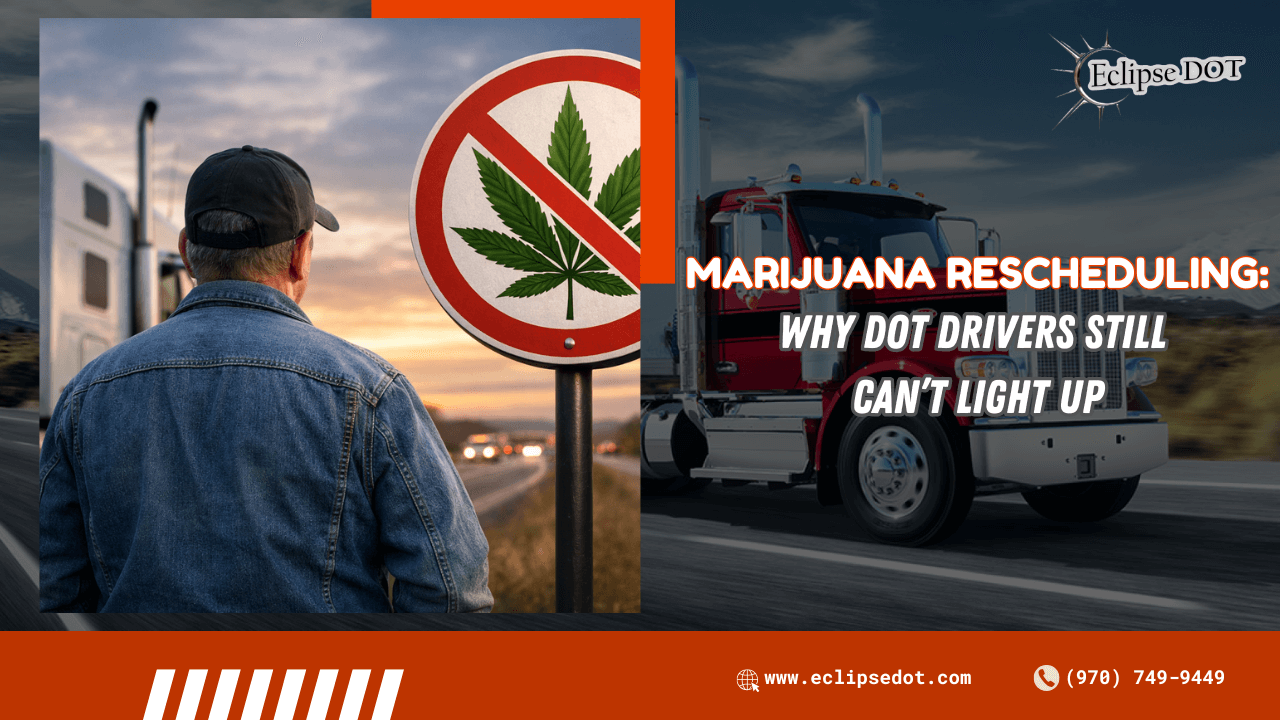
Whenever marijuana makes national headlines, the trucking industry reacts the same way.
Questions start coming in from drivers.
Articles get forwarded by fleet managers.
HR departments grow uneasy.
Eventually, someone confidently says, “So… I heard it’s legal now.”
Before that assumption causes real damage, it needs to be addressed clearly.
Despite marijuana moving closer to a different federal classification, DOT-regulated drivers still cannot use marijuana. That restriction applies recreationally, medically, off duty, on weekends, and even in states where marijuana is legal. Ignoring this reality remains one of the fastest ways for a driver to lose a CDL and for a fleet to jeopardize its compliance standing.
This article exists for one purpose: to eliminate confusion before confusion turns into violations.
What the Government Is Studying and What It Is Not Changing
Recently, President Donald Trump signed an executive order directing federal agencies to accelerate the review of marijuana’s classification under the Controlled Substances Act. As part of that process, the Food and Drug Administration received authorization to further evaluate marijuana’s potential medical value.
Soon after, in May 2024, the Drug Enforcement Administration and the Department of Justice issued a notice of proposed rulemaking to move marijuana from Schedule I to Schedule III.
At first glance, that proposal sounded decisive. Headlines framed it as a major shift. Many assumed finality.
However, that assumption missed the mark.
Schedule I substances are defined as having no accepted medical use and a high potential for abuse. Currently, marijuana remains in that category alongside heroin, LSD, and ecstasy. By contrast, Schedule III substances carry a moderate-to-low potential for physical or psychological dependence and include medications such as testosterone and products containing limited amounts of codeine.
Even if marijuana moves to Schedule III, several facts remain unchanged:
⭐ Federal legalization does not occur
⭐ Recreational use does not become legal
⭐ Prescriptions remain required
⭐ DOT drug testing rules do not automatically change
Among those points, the last one matters most to the trucking industry. Unfortunately, it is also the one most headlines overlook.
Why State Legalization Still Does Not Apply to DOT Drivers
Confusion usually starts at the state level.
Because marijuana is legal for medical use in most states and recreational use in many others, drivers often assume state law applies to their job. Given the interstate nature of trucking, that assumption feels logical.
Unfortunately, it is wrong.
DOT regulations operate federally, not locally. As a result, federal safety rules override state marijuana laws whenever a position qualifies as safety-sensitive.
That category includes:
⭐ Commercial truck drivers
⭐ School bus drivers
⭐ Pilots
⭐ Train engineers
⭐ Transit operators
⭐ Aircraft maintenance personnel
⭐ Maritime captains
⭐ Pipeline emergency response personnel
Following the executive order, Transportation Secretary Sean Duffy’s office reaffirmed this position by stating that safety-sensitive employees subject to DOT drug testing regulations remain prohibited from ingesting marijuana.
Previously, former Transportation Secretary Pete Buttigieg echoed the same point during congressional testimony. At that time, he clarified that DOT regulations identify marijuana by name, not by schedule. Therefore, the rule does not hinge on whether marijuana falls under Schedule I, II, or III.
If marijuana appears in DOT regulations, prohibition applies.
Why the Trucking Industry Is Not Celebrating
Industry leaders have made one thing clear: this issue is not political.
Instead, it is practical.
Safety remains the driving concern.
ATA Vice President of Safety Policy Brenna Lyles summarized it succinctly by stating that a safe driver is a qualified driver, and a qualified driver remains drug- and alcohol-free.
The underlying challenge persists because marijuana impairment cannot be reliably measured in real time. Unlike alcohol, no roadside test accurately determines current marijuana impairment. No breath-based equivalent exists. As a result, enforcement relies on prevention rather than reaction.
Until science produces a dependable impairment standard, DOT regulations must rely on prohibition as the only effective safety mechanism. This approach does not aim to punish drivers. Rather, it protects lives on the road.
The Regulatory Layer Most People Overlook
Beyond headlines, the regulatory structure becomes more complex.
DOT drug testing authority does not sit with a single agency. Instead, oversight is shared among:
⭐ DOT regulations under 49 CFR Part 40
⭐ FMCSA regulations under 49 CFR Part 382
⭐ Department of Health and Human Services, which establishes federal workplace drug testing guidelines
Under current HHS Mandatory Guidelines, regulated employers may test only for drugs listed under Schedule I or Schedule II of the Controlled Substances Act.
That limitation matters.
Safety advocates, including the National Transportation Safety Board, have warned that moving marijuana to Schedule III without corresponding guideline updates could introduce regulatory uncertainty. Such a gap would not suddenly permit marijuana use. Instead, it could complicate enforcement authority if agencies fail to remain aligned.
Because of that risk, trucking associations and safety organizations continue pushing for clarity before any final rescheduling takes effect.
Why This Is Already Affecting the Industry
This issue is not theoretical.
Marijuana accounts for nearly 60 percent of all positive DOT drug tests among commercial drivers, making it the most common violation by a wide margin.
When a driver tests positive, consequences follow immediately:
⭐ Clearinghouse reporting activates
⭐ Safety-sensitive duties stop
⭐ Fleet capacity drops overnight
⭐ Replacement drivers may not be available
⭐ Compliance reviews often follow
⭐ Insurance and liability exposure increases
More often than not, fleets hear the same explanation afterward:
“I thought it was legal now.”
That single misunderstanding has already sidelined thousands of drivers and disrupted operations nationwide.
What the Rules Still Say Clearly
To remove all doubt, the current reality remains unchanged:
⭐ Marijuana rescheduling does not alter DOT drug testing rules
⭐ DOT-regulated drivers remain prohibited from using marijuana
⭐ State legalization provides no protection
⭐ Positive drug tests remain violations
⭐ Clearinghouse consequences remain immediate and severe
No executive order overrides DOT safety regulations.
No headline rewrites federal enforcement.
How Smart Fleets Are Responding
Rather than waiting for confusion to spread, proactive fleets act early.
Today’s compliant fleets focus on:
⭐ Communicating expectations clearly
⭐ Reinforcing drug and alcohol policies
⭐ Reviewing Clearinghouse monitoring practices
⭐ Updating onboarding and refresher training
⭐ Auditing programs before enforcement occurs
At Eclipse DOT, this proactive approach defines how we help fleets operate with confidence. Our goal remains simple: prevent problems before they become shutdowns.
Once a violation occurs, options narrow quickly.
Final Word
Marijuana headlines will continue to surface.
Federal studies will move forward.
Social media will oversimplify the issue.
Meanwhile, DOT rules remain steady.
For drivers, this protects a CDL and a livelihood.
For fleets, it protects operations, reputation, and future stability.
If uncertainty exists around your drug and alcohol program, Clearinghouse monitoring, or compliance framework, now is the time to address it rather than waiting for a test result to force the issue.
Understanding the rules always costs less than learning them the hard way.
Gain exclusive access to our CDL & DOT Compliance articles with a trial at DOTDocs.com. And don’t forget to claim your FREE micro audit at THE ECLIPSE DOT MICRO AUDIT. Ready for seamless operations? Discover the difference today!
Sources
• FreightWaves – Will Marijuana Rescheduling Be a Game Changer for Trucking?
• Marijuana Moment – Federal Safety Board Warns Marijuana Rescheduling Could Imperil Drug Testing
• CCJ Digital – Can Truck Drivers Use Marijuana Once It’s Reclassified?
• Transport Topics – Trucking Reacts to DEA Proposal to Downgrade Marijuana