

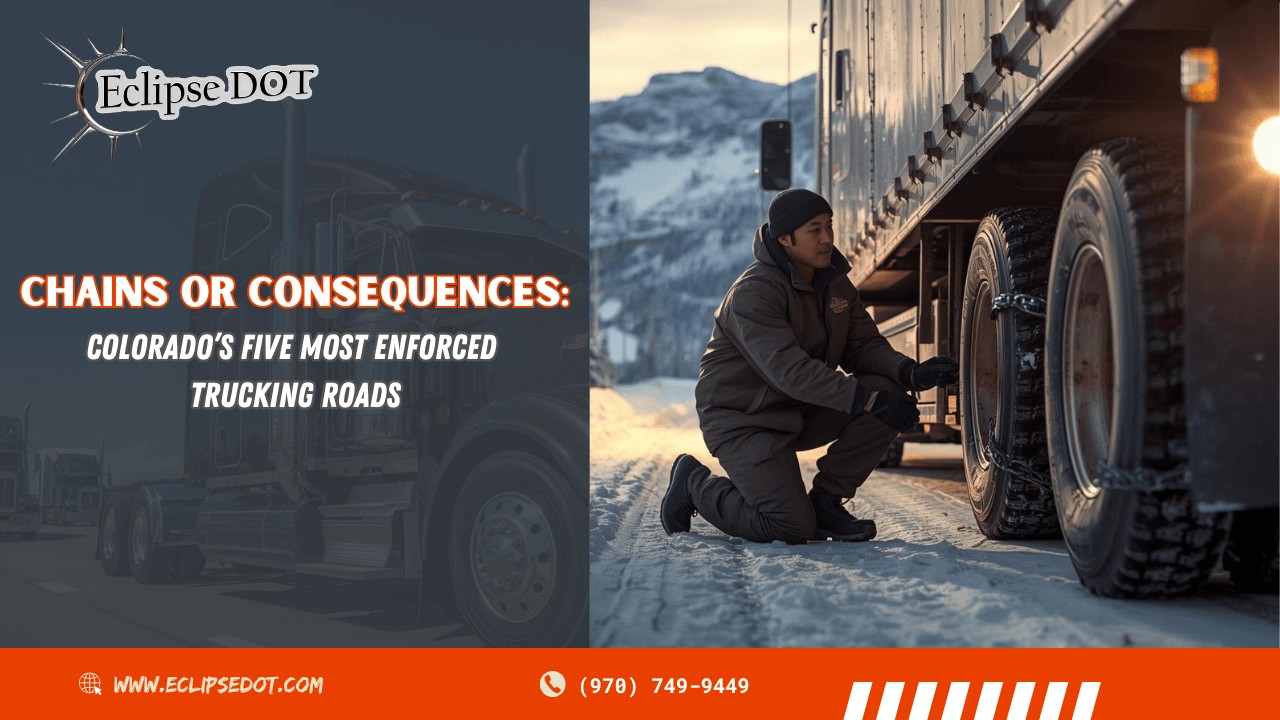
Winter in Colorado does not ask for permission. It takes what it wants. One moment the road is dry. The next, you are driving inside a snow globe with 80,000 pounds behind you. And every single winter, Colorado State Patrol writes the same tickets on the same roads to the same unprepared trucks.
The difference now is that CSP has four full years of data to prove it.
They are no longer guessing where chain-law violations happen most. They know exactly where fleets keep getting burned. And the list is not a surprise to anyone who has ever crossed the Rockies with freight on the deck.
If your trucks run Colorado, consider this your warning shot.
The Five Roads Where Chain Tickets Stack Up Fast
After reviewing four years of roadside enforcement and Port of Entry inspections, Colorado State Patrol identified the five highways where mandatory chain-carry violations occur most often:
★ I-70
★ Highway 160
★ Highway 50
★ Highway 255
★ Highway 550
I-70 sits at the top for a reason. It is the main supply artery to Western Slope communities and the front door into the Rocky Mountains. The traffic is constant. The grades are relentless. The weather shifts fast and without apology.
But here is the detail most fleets overlook.
Troopers are not just watching I-70.
Port of Entry officers and CSP units are enforcing chain compliance on multiple high-volume corridors statewide. Detouring around one mountain pass does not mean you detour around the law.
The Law Changed and Thousands of Trucks Never Changed With It
In 2024, Colorado passed Senate Bill 24-100. It quietly expanded the mandatory chain-carry law. But while the legislation moved quickly, many fleet policies did not.
Today, from September 1 through May 31, commercial motor vehicles must carry chains or approved alternative traction devices on designated roadways regardless of present weather conditions.
That is where companies get caught.
Blue skies do not excuse missing chains. Dry pavement does not suspend the rule. If the calendar and the roadway say “must carry,” the equipment must already be on the truck.
The required-chain corridor network now includes:
★ All of U.S. Route 550
★ I-70 west of mile marker 259 in Morrison to the Utah border
★ Colorado Highway 9 between Frisco and Fairplay
★ Route 40 west of Empire to the Utah border
★ U.S. Route 50 west of Salida to the Utah border
★ U.S. Route 160 west of Walsenburg to the New Mexico border
★ U.S. Route 285 west of Morrison to the New Mexico border
This expansion dramatically widened the compliance footprint across the state. Some companies updated policy binders. Far fewer updated dispatch habits, route planning software, or pre-trip verification systems.
And enforcement made sure the gap became visible.
Enforcement Is Not Symbolic. It Is Aggressive and Consistent.
Colorado State Patrol did not expand the rule and then stand down.
Over the most recent winter season, more than 1,300 chain-law citations were issued statewide. Weekly enforcement sweeps along the I-70 mountain corridor alone resulted in thousands of CMV contacts and well over a hundred chain-carry violations.
During single-day chain-check operations, hundreds of commercial trucks were inspected, and dozens of citations were issued in a matter of hours.
This is not “warning-first” enforcement.
This is compliance-by-inspection enforcement.
Why I-70 Continues to Be the Epicenter of Risk
I-70 remains the roadway with the highest number of CMV-related crashes in Colorado. It is the primary focus for:
★ Winter enforcement
★ Safety inspections
★ Educational outreach
★ Runaway truck ramp monitoring
When CSP analyzed runaway truck ramp usage along I-70, a revealing pattern appeared.
Sixty-five percent of drivers who used a ramp had five years or less of driving experience.
That stat tells a hard truth.
Mountain driving is not just another route assignment. It is an advanced operating environment that requires restraint, foresight, and humility behind the wheel. When inexperienced drivers are pushed into high-risk corridors without proper coaching, gravity becomes the instructor.
And that instructor is ruthless.
This Is Not a Chain Problem. It Is a Leadership Systems Problem.
If chain violations were simply about drivers refusing to carry equipment, the fix would be easy. But that is not what audits reveal.
What Eclipse DOT sees over and over again is not defiance. It is system failure.
Common breakdowns include:
★ Dispatch releasing trucks into mandatory chain corridors without confirming equipment
★ New drivers assigned to major mountain grades without structured mountain training
★ Seasonal safety talks happening after tickets spike
★ Chains that exist on paper but not in serviceable condition
★ Leadership believing “experience alone” eliminates risk
Chains are the final safeguard. The failures that create violations almost always occur long before the truck hits the grade.
The Ticket Is the Smallest Part of the Damage
Most drivers see the fine. Fleet leaders feel everything that follows.
One chain-law violation can trigger:
★ CSA score increases
★ Higher roadside inspection probability
★ Insurance premium pressure
★ Shipper confidence issues
★ FMCSA intervention
★ Civil liability exposure if a crash follows
When violations occur on highly visible corridors like I-70, the damage multiplies. Traffic backs up for miles. Cameras roll. Social media clips spread before the incident report is even written.
By the time management receives the call, the business impact is already in motion.
Why New Drivers Are Overrepresented in Mountain Emergencies
The runaway ramp data points to a broader truth in modern trucking.
Drivers with fewer than five years of experience make up most emergency ramp activations along Colorado’s most dangerous corridor. That is not because they lack intelligence. It is because mountain judgment is developed through structure, time, and exposure.
Mountain driving demands:
★ Gear discipline
★ Brake heat management
★ Descent planning
★ Weather pattern interpretation
★ High-pressure risk assessment
These skills are not instinctual. They must be taught, practiced, and reinforced. Without that framework, good drivers can make catastrophic decisions in seconds.
The Seasonal Compliance Trap That Keeps Repeating
Every winter looks the same inside many companies.
Tickets rise. Leadership reacts. Emergency training is rolled out. Policy memos go out. Promises are made.
Then spring arrives.
Enforcement cools down. Attention shifts to freight volume and summer operations. The urgency fades.
By the next winter, the same trucks are missing the same chains on the same grades.
True compliance cannot be reactive. It must be baked into daily operations.
What High-Performing Fleets Do That Others Do Not
The fleets that stay off Colorado’s enforcement radar treat chain compliance like an operational discipline, not a seasonal inconvenience.
They consistently implement:
★ Mandatory chain-equipment verification before mountain dispatch
★ Digital route planning that flags must-carry corridors
★ Structured mountain-driving training programs
★ Pre-season safety briefings that begin before September
★ Surprise chain-readiness spot checks
★ Leadership oversight at the dispatch, safety, and executive levels
Winter still happens to these fleets. Snow still falls. But violations become rare events instead of routine costs of doing business.
Where Eclipse DOT Fits Into the Equation
Regulatory changes rarely come with alarms. Enforcement comes later. That gap is where most fleets get exposed.
Eclipse DOT helps close that gap by:
★ Auditing chain-carry compliance across routing systems
★ Updating written safety programs to reflect real law
★ Training drivers and dispatch on mandatory chain corridors
★ Identifying exposure before inspections uncover it
★ Protecting CSA scores and insurance standing
★ Building long-term compliance systems that hold up under real enforcement
We do not sell binders. We build operations that survive pressure.
The Bottom Line for Colorado Fleets
If your trucks run any of the following routes between September 1 and May 31, chain carry is mandatory regardless of current weather:
★ I-70 mountain corridor
★ U.S. 50 west of Salida
★ U.S. 160 west of Walsenburg
★ U.S. 285 west of Morrison
★ Highway 9 between Frisco and Fairplay
★ Route 40 west of Empire
★ All of U.S. Route 550
Colorado State Patrol is enforcing this law with consistency, data, and zero tolerance for excuses.
Hope is not a compliance strategy. Preparation is.
A Final Word for Fleet Leaders and Drivers
Chains represent more than steel on tires. They represent discipline, foresight, and leadership.
Every chain-law citation reflects a breakdown somewhere upstream in training, dispatch, operations, or executive oversight.
Mountain roads do not give warnings. Enforcement does not bend. Physics does not compromise.
Colorado has made its priorities clear.
Now fleets must decide where theirs stand.
Want to Know If Your Fleet Is Exposed Right Now?
Eclipse DOT offers a free DOT micro audit to expose compliance gaps before they become citations, shutdowns, or lawsuits.
We will review your chain policies, dispatch processes, training systems, and equipment readiness.
Because explaining a late delivery is uncomfortable.
Explaining why a truck never made it off the mountain is devastating.
Sources
• Colorado State Patrol – Chain Law Information and Violation Locations
• Colorado General Assembly – Senate Bill 24-100
• CDLLife – Colorado Weekly Chain Check Enforcement Results
• KKTV – Colorado State Patrol Chain Check Operations
• Denver Gazette – I-70 Commercial Vehicle Chain Inspections
• Colorado Department of Transportation – Must Carry Law Updates